
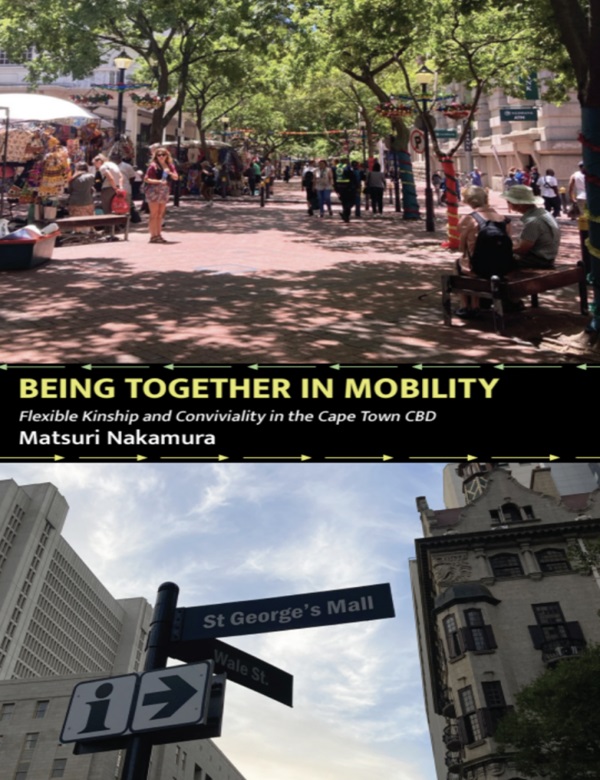
written by Matsuri Nakamura
Flexible Kinship and Conviviality in the Cape Town CBD
This ethnographic study explores how diverse individuals encounter, interact, and share urban public space in the Cape Town CBD, specifically focusing on St. George’s Mall. Using decolonial anthropological methods – including participant observation as a “flexible shop assistant” – the research investigates the complex relationships between people, products, and place. Nakamura characterises the street as a site of “constant circulation”, where transnational and transregional mobility is a normal way of being. At the heart of this vibrant ecosystem is the concept of “flexible kinship”, a practice where traders from various backgrounds form a “family” to survive economic precarity and navigate the daily anxieties of xenophobia. By embracing their “incompleteness”, these street dwellers foster conviviality – an attitude of living together by balancing tensions rather than denying them. Ultimately, this work presents the urban street as a powerful metaphor for “open-ended belonging”, offering a hopeful alternative to the exclusionary fortification often found in modern globalised cities.
£24.00


Publisher: Langaa RPCIG
Pages: 158
Year: 2026
Category: African Studies
Dimensions: 203×127 mm
ISBN: 9789956004379
Shipping class: POD
2 comments
“Grounded in the concepts of circulation and conviviality, Nakamura’s ethnography offers a profound look at how we share space in a complex world. By treating the urban street as both a physical site and a powerful metaphor, this work illuminates how the fundamental relations of identity and security are shaped on the ground.” – Ignasio Malizani Jimu, Associate Professor of Anthropology, Malawi University of Science and Technology
“Nakamura’s keen attention to the unfolding sociality of the street provides a vital map of compassion, hope, and care. In urban environments too often dismissed as postcolonial necropolises – defined by extraction and predation – this book offers a hopeful, open-ended vision of conviviality. For its celebration of these paradoxes and the vibrant promise of life on the street, this work deserves a wide readership.” – Bjørn Enge Bertelsen, Professor, Department of Social Anthropology, University of Bergen, Norway